Access and edges · IBC and ADOSH
Mezzanine Safety Gates, Stairs and Guardrail in Phoenix
We supply and install mezzanine safety gates, stairs, guardrail and ladders across Phoenix. Each part is checked against two rule books at once: the 2024 IBC the City enforces, and the federal 29 CFR 1910 rules that ADOSH applies in Arizona workplaces.
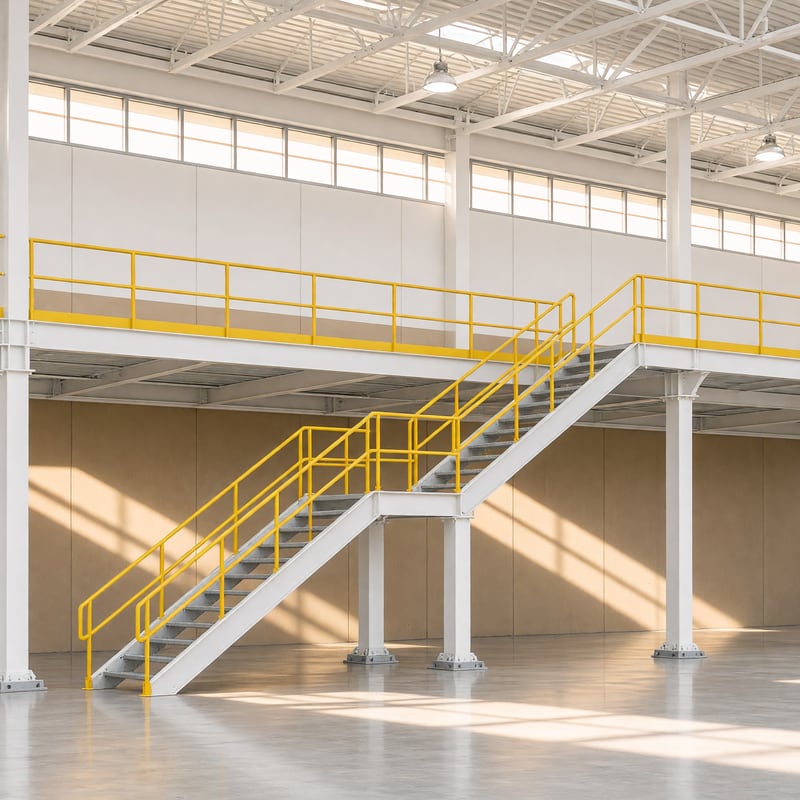
Which Rules Set Stairs, Rails and Gates in Phoenix?
Two sets apply at the same time. The City enforces the 2024 Phoenix Building Construction Code, which adopts the 2024 IBC and took effect on August 1, 2025; its amendment sheets leave the stair, handrail and guard sections unchanged. In the workplace, ADOSH, part of the Industrial Commission of Arizona, runs the state's own OSHA plan. Arizona rule R20-5-602 adopts the federal 29 CFR 1910 general industry standards as of July 14, 2020, and the walking-working surface rules took effect in 2017, so ADOSH applies them. The two sets do not always agree. Where they part ways, our drawings satisfy both.
| Item | IBC 2024, City of Phoenix | 29 CFR 1910, ADOSH |
|---|---|---|
| Edge protection begins at | A drop of more than 30 in | A drop of 4 ft or more |
| Guard or top rail height | 42 in or taller | 42 in, plus or minus 3 in |
| Largest opening in the guard | 4 in sphere; 21 in sphere at equipment access walkways and in F, H, S or I-3 areas closed to the public | 19 in |
| Load on the rail | 200 lb point load; 50 lb per linear foot | 200 lb on the top rail; 150 lb on the midrail |
| Stair riser and tread | Riser 7 in or less; tread 11 in or more | Riser 9.5 in or less; tread 9.5 in or more |
| Stair width | 44 in; 36 in for fewer than 50 occupants | 22 in between vertical barriers |
| Headroom over the stair | 80 in | 6 ft 8 in |
| Handrail height | 34 to 38 in | 30 to 38 in |
The longer comparison is in building code stairs versus ADOSH stairs. How these rules sit inside the permit is on our Phoenix permits and code page.
What Do Mezzanine Stairs Need to Pass Both Rule Sets?
Under the IBC: risers of 7 inches or less, treads of 11 inches or more, and 80 inches of headroom over the nosings. The stair is 44 inches wide, or 36 inches when it serves fewer than 50 people, with handrails 34 to 38 inches high. Meeting those numbers also clears the ADOSH limits of 9.5-inch risers and treads, 22 inches of width and 6 feet 8 inches of headroom. ADOSH then adds its own items: a stair angle between 30 and 50 degrees, landings no narrower than the stair and no less than 30 inches deep, and strength of five times the expected load, never under a 1,000-pound point load.
- ADOSH rule 1910.28(b)(11)(ii): "Each flight of stairs having at least 3 treads and at least 4 risers is equipped with stair rail systems and handrails".
- Stair rails installed since January 17, 2017 stand at least 42 in above the front edge of the tread (1910.29(f)(1)(ii)(B)).
- In a Group F building, a guard on a private exit access stair serving fewer than three stories may double as the handrail at 34 to 38 in (IBC 1015.3 exception).
- Stairs and exits are designed for 100 psf, plus a 300 lb point load (IBC Table 1607.1, row 32).
A steep ship ladder can reach an equipment platform: the IBC lists ladders and alternating tread devices as platform access, and none of them counts as an exit from the building (505.3). We choose the stair from your traffic and floor space as part of our mezzanine installation in Phoenix.
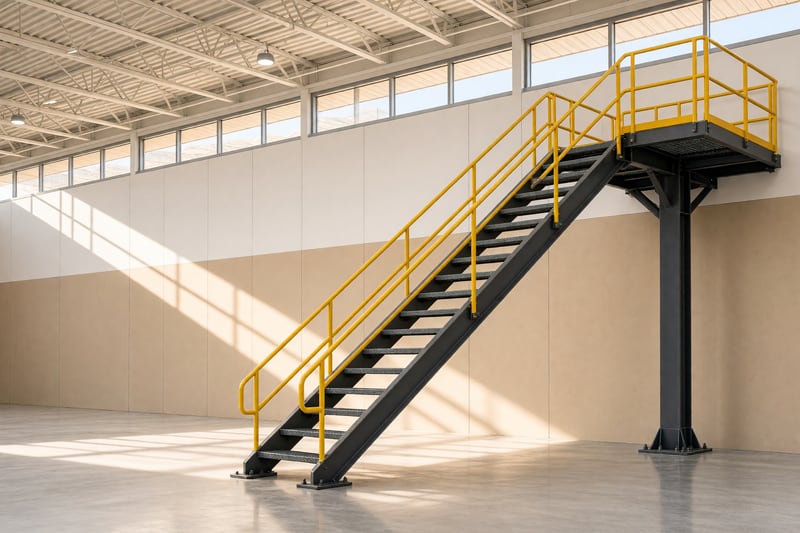
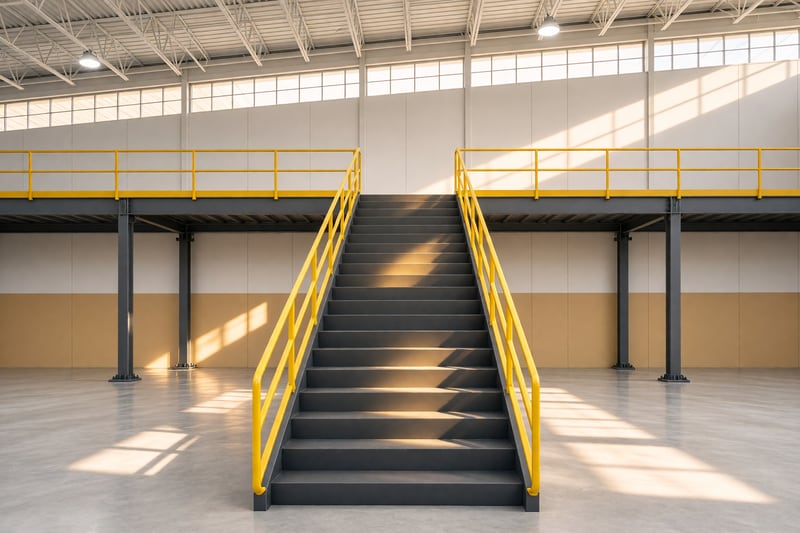
How High and How Strong Must Mezzanine Guardrail Be?
The top rail stands at least 42 inches above the walking surface, and ADOSH accepts 42 inches plus or minus 3. The IBC asks for guards on open sides more than 30 inches above the floor below, measured anywhere within 36 inches of the edge, and it names mezzanines and equipment platforms. ADOSH starts at 4 feet. A midrail runs halfway up. The IBC sphere test is 4 inches; in Group F, H, S or I-3 areas closed to the public, such as factory and storage floors, it widens to 21 inches, but ADOSH caps openings at 19 inches, so we draw to 19 there. Toeboards stand at least 3.5 inches tall.
- Top rail: holds 200 lb pushed down or out within 2 in of its top edge, and does not sag below 39 in (1910.29(b)(3), (b)(4)).
- Midrail: holds 150 lb in any downward or outward direction (1910.29(b)(5)).
- IBC design loads on guards and handrails: a 200 lb point load and 50 lb per linear foot (1607.9.1, 1607.9.1.1).
Read why the two rules begin at 30 inches or 4 feet, and how the 4, 19 and 21-inch opening rules fit together.
Which Mezzanine Safety Gate Fits a Pallet Drop Zone?
One that keeps the edge closed while a pallet goes in. On a two-gate bay, such as a pivot gate, the deck-side gate shuts before the outer gate opens, so the drop is never left bare. ADOSH treats the drop as a hoist area: "any elevated access opening to a walking-working surface through which equipment or materials are loaded or received". Anyone there facing a fall of 4 feet or more needs guardrail, a personal fall arrest system or travel restraint (1910.28(b)(2)(i)). Under 1910.29(b)(10), an employer may use "chains or gates instead of a removable guardrail section at hoist areas" only after showing they protect as well as guardrail.
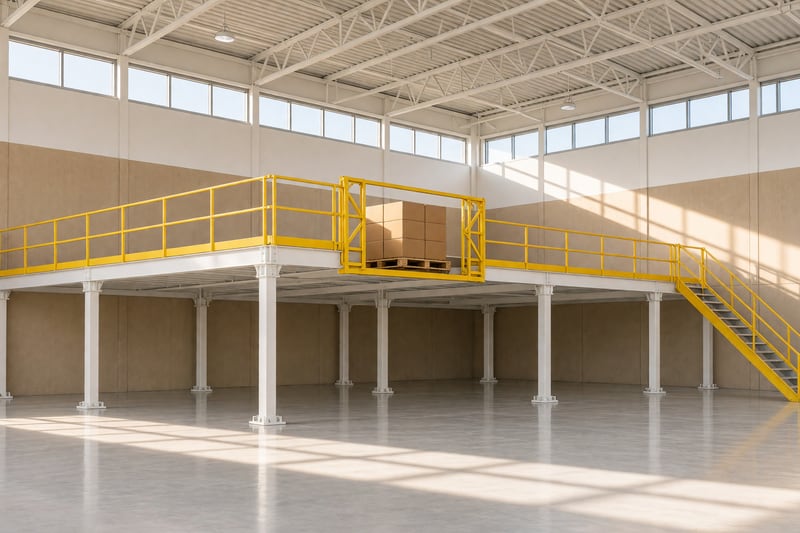
A two-gate bay lets the forklift set the pallet inside while the deck side stays shut, so nobody leans out to receive it. We supply each gate with the guardrail and bolt both to the frame. Compare gates and lifts in our mezzanine options gallery, or skip the drop with a mezzanine lift.
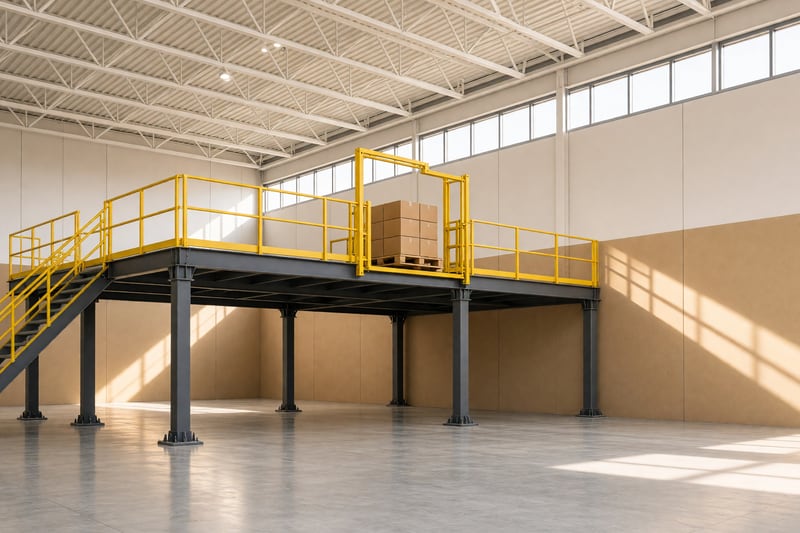
When Do Sliding, Rolling or Swing Pallet Gates Make Sense?
When pallets arrive now and then, and the crew on the deck follows a set routine. A sliding gate runs along a track across the opening, a rolling gate travels on wheels, and a swing gate turns on a post. Each one opens the edge while the load goes in, so the open time has to be short and managed. They take less depth than a two-gate bay, which helps on narrow decks. For steady pallet traffic, a two-gate bay keeps the edge closed without relying on habit. See how stairs and gates add to the total on our mezzanine cost guide.
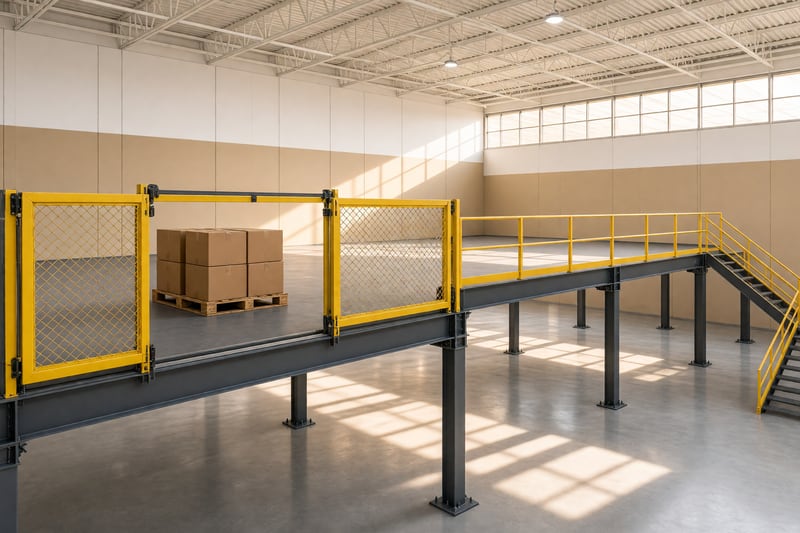
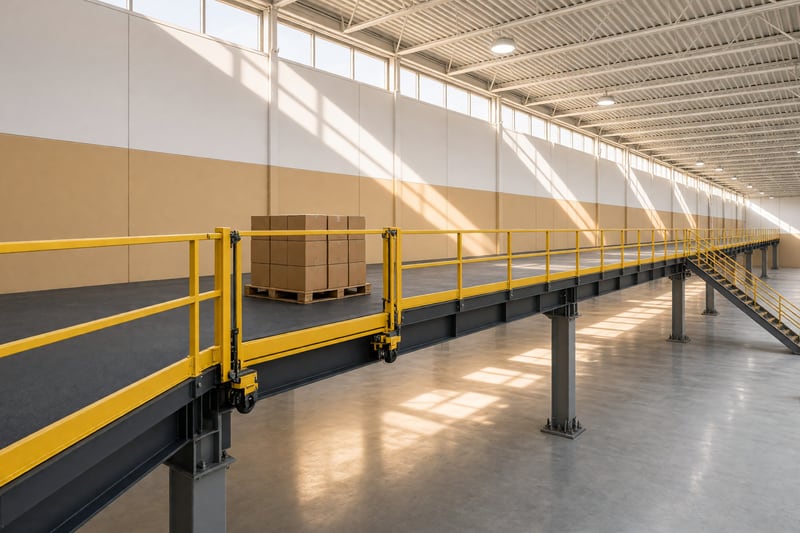
What Rules Apply While a Pallet Gate Stands Open?
The open edge is still a hoist area, so the 4-foot fall protection rule keeps applying. ADOSH adds a line for that exact moment. When part of a guardrail, a gate or a chain is removed and a worker has to lean through or over the edge to help with hoisting, that worker is protected by a personal fall arrest system (1910.28(b)(2)(ii)). A sound routine keeps people back from an open edge. An amber beacon or an alarm wired to the gate tells the deck and the floor below that an edge is open, and we can fit one to any gate we supply.
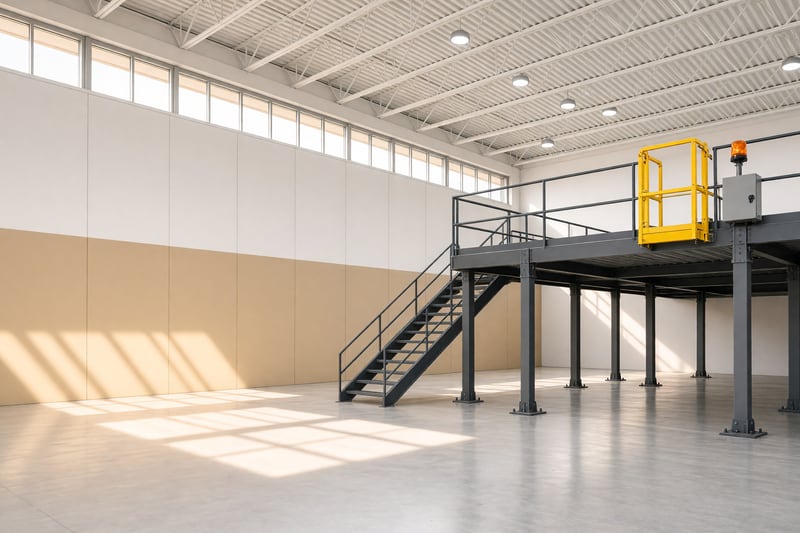
What Goes at the Top of a Stair or Ladder Opening?
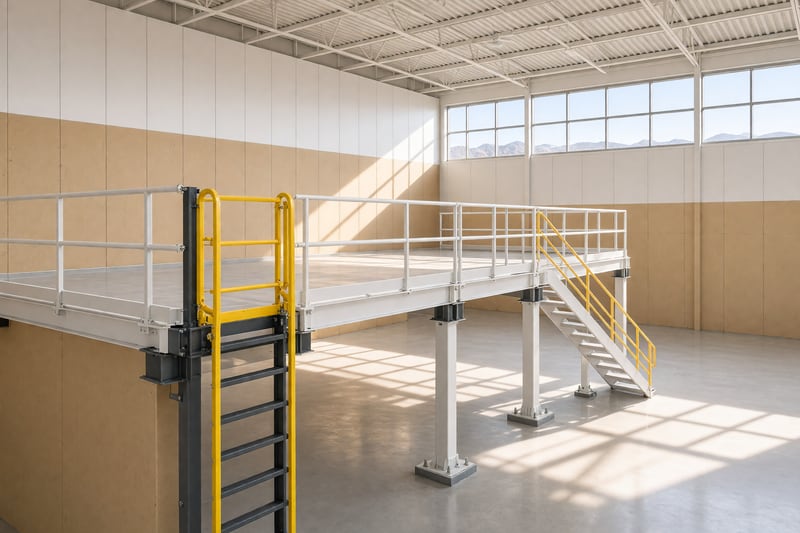
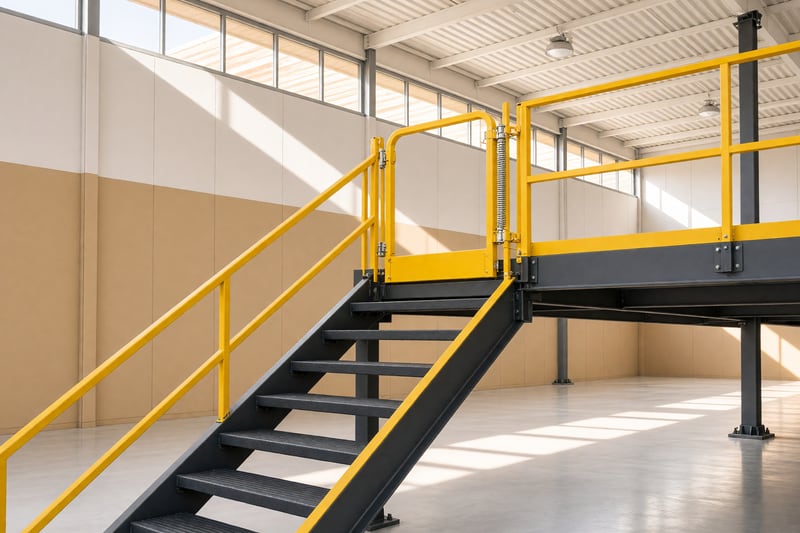
Either a gate that closes on its own or a rail layout that stops anyone walking straight in. Where guardrail rings an opening used for access, 1910.29(b)(13) says the system "Has a self-closing gate that slides or swings away from the hole" with a top rail and midrail, or "Is offset to prevent an employee from walking or falling into the hole". Fixed ladders that rise more than 24 feet carry dated rules: each one installed on or after November 19, 2018 must be "equipped with a personal fall arrest system or a ladder safety system", and from November 18, 2036 every such ladder needs the same. We show each opening and its gate on the drawings before steel is ordered.
What Does a Stair, Rail and Gate Project Include?
A stair, rail and gate job covers the flights and landings, guardrail with midrails and toeboards on every open edge, a gate at each pallet drop and ladder top, and a line-by-line check against both the IBC and ADOSH. You order it from us, and our own crew puts it up, from the first measurements to the last inspection. We line up the engineer's sealed drawings and the permit filing with the City of Phoenix. A single order and a single crew, with one person to call.
- Site visit: floor size, clear height, slab and the way stock moves.
- Layout tested against IBC 505 and the ADOSH rail and stair rules before any steel is bought.
- Drawings sealed by an Arizona-registered engineer, and the permit filing.
- Delivery of the columns, beams, deck, stairs, guardrail, gates and any lift.
- Our crew installs it, then the inspections and the posted load signs.
Sources, read November 2026: Phoenix Building Code 2024, Chapter 10 means of egress, via UpCodes · Phoenix Building Code 2024, Table 1607.1, via UpCodes · Phoenix Building Code 2024, Section 505, via UpCodes · City of Phoenix, 2024 IBC amendment sheets · OSHA, Arizona State Plan · Ariz. Admin. Code R20-5-602, via Cornell LII · Federal Register 2016-24557, Walking-Working Surfaces · OSHA 29 CFR 1910.21 · OSHA 29 CFR 1910.25 · OSHA 29 CFR 1910.28 · OSHA 29 CFR 1910.29
01Questions
Stair, Rail and Gate Questions, Answered
How tall must mezzanine guardrail be in Phoenix?
At least 42 inches above the walking surface. The IBC sets 42 inches as the minimum, and ADOSH accepts 42 inches plus or minus 3, so a 42-inch top rail meets both. A midrail runs at mid-height, between deck and top rail.
Source: IBC 1015.3; 29 CFR 1910.29(b)(1), (b)(2)(i)
Can a chain close a mezzanine pallet drop in Phoenix?
Only when the employer can show the chain protects as well as guardrail does. That test comes from 1910.29(b)(10), which ADOSH applies to chains or gates used at hoist areas. We usually quote a two-gate bay, which keeps the edge shut while the pallet is loaded.
Source: 29 CFR 1910.29(b)(10)
Which stair rule wins in Phoenix when the IBC and ADOSH differ?
Neither replaces the other, so the stair has to pass both. The IBC numbers are tighter for risers, treads and width, and a stair built to them also clears ADOSH. ADOSH adds the 30 to 50 degree stair angle and the 30-inch landing depth.
Source: IBC 1011; 29 CFR 1910.25
Do the ADOSH rules apply to my mezzanine in Phoenix?
For private employers and for state and local government employers, yes. ADOSH runs Arizona's OSHA state plan and adopts 29 CFR 1910 by reference, rail, stair and gate rules included. The plan does not cover federal government employers, and federal OSHA keeps some sites, such as Indian reservations.
Source: OSHA, Arizona State Plan; A.A.C. R20-5-602
02Request for quote
Build Your Quote
Give us the room, the height and the load you have in mind. A Valley installer answers with questions or a written price.
- 1You send the floor size, the clear height and the use.
- 2We test the plan against IBC 505 and the ADOSH rules.
- 3You receive a written quote that lists each step.
Prefer to talk? (928) 232-1752
Build Up Inside Your Phoenix Building
- Rated for what you store.
- Drawn to the 2024 Phoenix code.
- Installed around your schedule.