Guard guide · IBC 1015 and 1910.28
30 Inches or 4 Feet? Why the Building Code and ADOSH Guard Edges at Different Heights
The building code Phoenix enforces calls for a guard once an open edge sits more than 30 inches above the floor below. The federal rule that ADOSH applies starts at 4 feet. The band between them catches low platforms, walkways and landings, so it pays to know which rule reaches each edge.
When Does an Open Edge Need a Guard?
It depends on which rule you read. IBC 1015.2, as Phoenix adopted it, puts guards along open-sided walking surfaces, "such as mezzanines, equipment platforms, aisles, stairs, ramps and landings," once they sit more than 30 inches above the floor or grade below. ADOSH applies 29 CFR 1910.28(b)(1)(i), which starts worker protection when the drop from an open side reaches 4 feet.
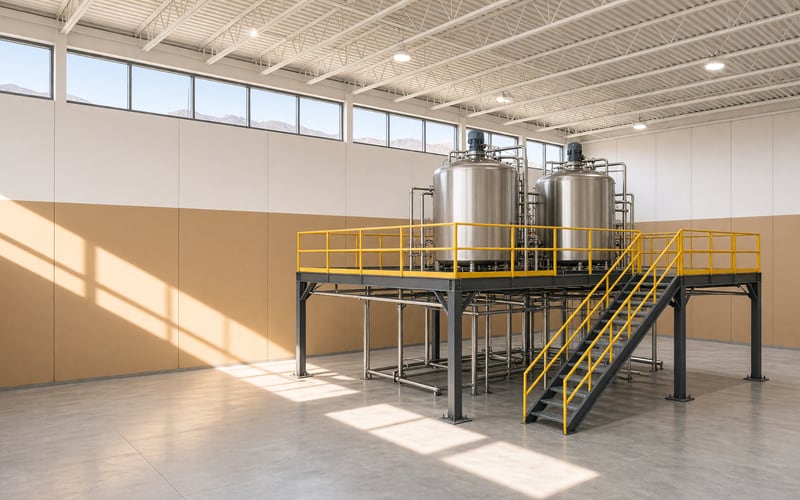
That 18-inch band decides how many raised edges in a plant need a guard. It matters most on industrial work platforms and on catwalks and crossover bridges, where some decks sit only a few feet up.
Why Do the Two Rules Use Different Heights?
They come from different codes with different jobs. The building code governs the building, and Phoenix plan review applies it to the drawings before a permit is issued. The ADOSH rule governs the workplace and protects employees while they work. Neither replaces the other, so a raised edge in a Phoenix plant answers to both.
They also measure in different ways. The IBC checks the drop "at any point within 36 inches (914 mm) horizontally to the edge of the open side," so a pit or a step-down near the edge counts. The federal rule looks at how far the edge sits above the next level down.
Which Edges Fall Between 30 Inches and 4 Feet?
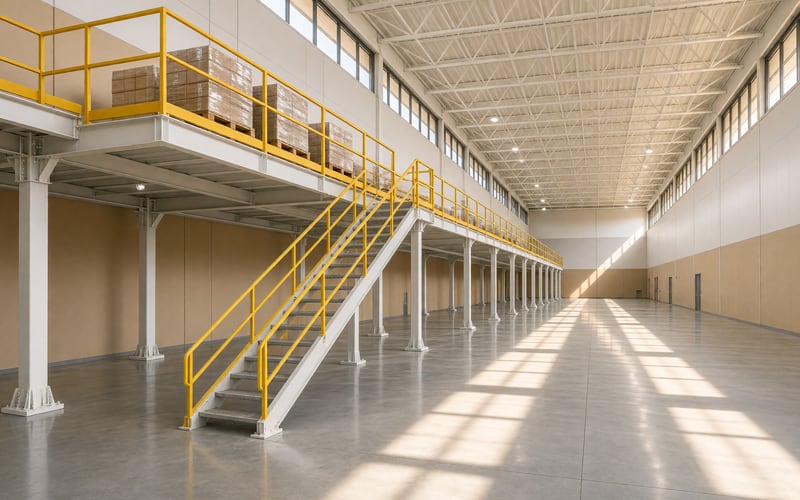
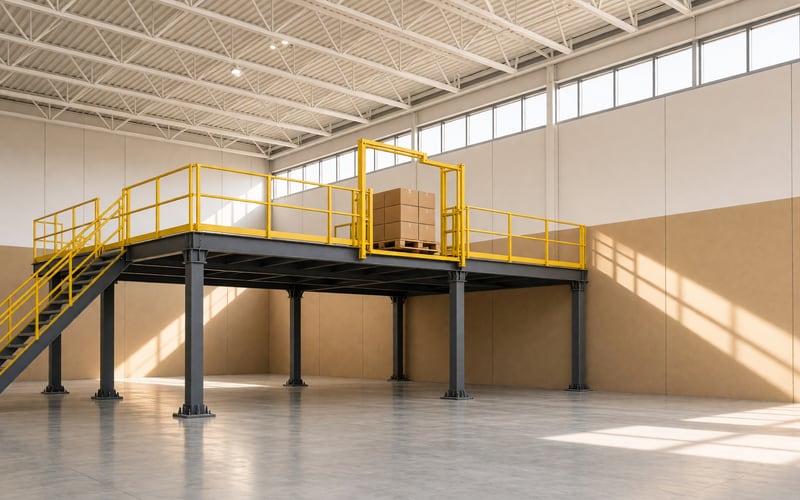
Low decks that people stand on but rarely think of as mezzanines. Under the building code, each one takes a guard once its open side passes 30 inches, even though the ADOSH trigger is still some way off. A few common cases in Valley plants are listed below, and plan review confirms each one on your drawings.
- A work platform beside a machine, a mixer or a filling line.
- A raised walkway that runs along a conveyor or a packing line.
- A stair landing, or the open side of a short stair.
- A crossover deck over a low conveyor.
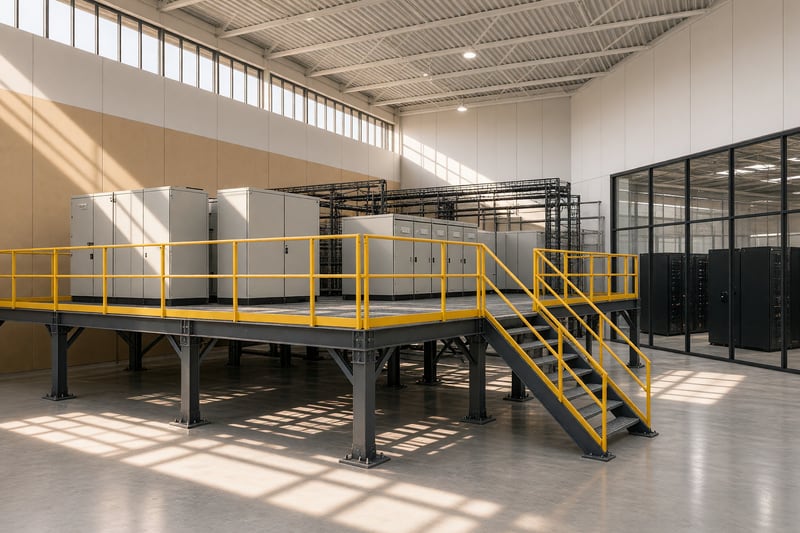
- An equipment platform, which IBC 505.3.3 says "shall have guards where required by Section 1015.2."
Phoenix also waives the permit for some platforms of 30 inches or less that sit over no story and are not part of an accessible route. Waiving the permit does not waive the code. Our guide to platform permit exemptions in Phoenix sets out the limits.
Do Catwalks and Crossovers Follow the Same Triggers?
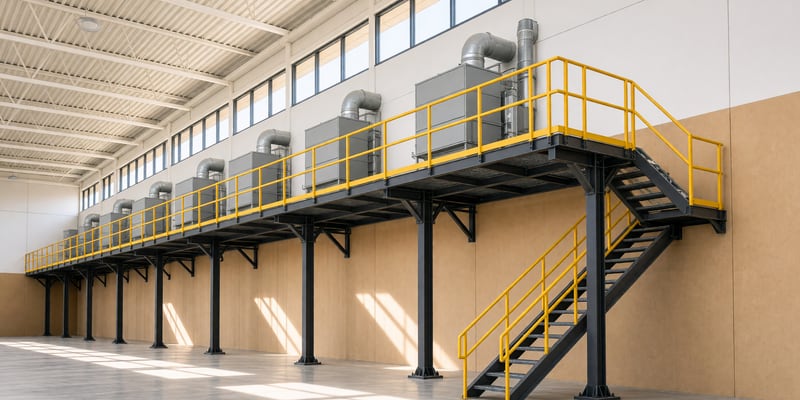
Yes. Section 1015.2 lists aisles, stairs, ramps and landings right beside mezzanines, so a walkway is judged on its height like any deck. A catwalk out to roof units usually sits far above both triggers. A crossover over a conveyor may sit lower, and its stairs and landings each count as open-sided surfaces of their own.
The live load differs by use as well. In Table 1607.1, a service catwalk carries 40 psf plus a 300-pound point load, while walkways and elevated platforms carry 60 psf. Our guide to choosing the live load row walks through that choice.
How High Must the Guard Be Once One Is Required?
At least 42 inches under the building code, and 42 inches give or take 3 under ADOSH. IBC 1015.3 says required guards "shall be not less than 42 inches (1067 mm) high." Section 1910.29(b)(1) puts the top rail at "42 inches (107 cm), plus or minus 3 inches (8 cm), above the walking-working surface." Read together, a guard from 42 to 45 inches tall satisfies both.
The federal rule adds a load check. Under a 200-pound push, the top rail may not drop below 39 inches. We take every height from the finished deck surface, since grating, plate or board changes where people actually stand.
Where Else Do the Building Code and ADOSH Differ at an Edge?
In gaps and in loads. The building code tests openings with spheres, while the federal rule caps the gap between balusters at 19 inches. The building code designs a guard for a 200-pound point load and 50 pounds per linear foot; the federal rule tests the top rail at 200 pounds and the midrail at 150. The table lines up the edge figures.
| Item | Building code (IBC 2024) | ADOSH (29 CFR 1910) |
|---|---|---|
| Protection begins | Over 30 in, checked within 36 in of the edge (1015.2) | A 4 ft drop (1910.28(b)(1)) |
| Guard height | 42 in or more (1015.3) | 42 in, give or take 3 in (1910.29(b)(1)) |
| Openings | 4 in sphere; 21 in sphere in listed areas (1015.4) | Gaps of 19 in at most (1910.29(b)(2)) |
| Design loads | 200 lb point; 50 plf (1607.9.1, 1607.9.1.1) | Top rail 200 lb; midrail 150 lb (1910.29(b)(3), (b)(5)) |
Our guide to the 4, 19 and 21 inch opening rules goes deeper on what fills the guard.
How Do We Draw an Edge That Meets Both Rules?
We start from the lower trigger and the tighter figure. Any open side more than 30 inches up gets a guard on the drawings, whether or not it reaches 4 feet. The guard stands 42 inches or a little more, its infill passes the sphere test that applies, and its posts and rails carry the building code loads and the federal rail tests.
Plan review then checks the building code side, and the finished edge serves the ADOSH side once work starts. That is how our Phoenix mezzanine installers handle each deck, platform and walkway we supply and put up.
Guard Height Questions, Answered
Does a 3-foot platform in a Phoenix plant need a guard?
Under IBC 1015.2 as Phoenix adopted it, an open side more than 30 inches above the floor below takes a guard, and 3 feet is 36 inches. ADOSH's 4-foot trigger is not reached, but the building code guard still applies. Plan review confirms it for your layout.
Source: IBC 1015.2; 29 CFR 1910.28(b)(1)
What guard height meets both codes in Phoenix?
A guard from 42 to 45 inches tall. IBC 1015.3 sets 42 inches as the minimum, and 29 CFR 1910.29(b)(1) puts the top rail at 42 inches give or take 3 inches.
Source: IBC 1015.3; 29 CFR 1910.29(b)(1)
Does ADOSH use the 4-foot figure for holes and pallet drops in Phoenix?
Yes. Under 29 CFR 1910.28(b)(2) and (b)(3), hoist areas and holes are protected once the fall would be 4 feet or more. A pallet drop is a hoist area, so it takes guardrails, fall arrest, or chains or gates the employer can show give equal protection.
Source: 29 CFR 1910.28(b)(2), (b)(3) and 1910.29(b)(10)
Do equipment platforms in Phoenix need guards?
Wherever Section 1015.2 calls for them. IBC 505.3.3 ties equipment platform guards to that section, so an open side more than 30 inches above the floor below takes one.
Source: IBC 505.3.3 and 1015.2
Sources, read November 2026: Phoenix Building Code 2024, Chapter 10 means of egress, via UpCodes · Phoenix Building Code 2024, Section 505, via UpCodes · Phoenix Building Code 2024, Table 1607.1, via UpCodes · OSHA 29 CFR 1910.28 · OSHA 29 CFR 1910.29 · Ariz. Admin. Code R20-5-602, via Cornell LII