Guard guide · IBC 1015.4
Guard Openings on Industrial Mezzanines: The 4-Inch, 19-Inch and 21-Inch Rules
Three numbers decide what fills the space under a mezzanine top rail. The building code tests openings with a 4-inch sphere, or a 21-inch sphere in some industrial areas. The federal rule ADOSH applies caps the gap between balusters at 19 inches. Which ones govern depends on who uses the deck.
What Do the 4-Inch, 19-Inch and 21-Inch Numbers Mean?
They are three ways of limiting the gaps in a guard. The 4-inch and 21-inch figures come from IBC 1015.4 in the code Phoenix enforces, and each one is the diameter of a sphere that must not pass through. The 19-inch figure comes from 29 CFR 1910.29(b)(2), which ADOSH applies, and it is the widest gap allowed between balusters or other members.
Which figure governs depends on the occupancy and on who can reach the deck. You can compare infill types among our mezzanine stairs, railings and gates, and decks carried on racks among our rack-supported mezzanines.
Where Does the 4-Inch Sphere Rule Apply?
Everywhere the code does not list an exception. IBC 1015.4 says required guards "shall not have openings that allow passage of a sphere 4 inches (102 mm) in diameter from the walking surface to the required guard height." The test runs the full height of the guard, not just its lower part. Offices on a deck, sales areas and anything open to the public usually fall here, and plan review sets the occupancy.
A top rail with one midrail leaves gaps many times wider than 4 inches. So a 4-inch area needs real infill from the deck up to the rail: wire mesh, close-set pickets or solid panels.
When Can Guard Openings Reach 21 Inches?
In two cases that IBC 1015.4 lists. The first is "At elevated walking surfaces for access to and use of electrical, mechanical or plumbing systems or equipment." The second covers "areas that are not open to the public within occupancies in Group I-3, F, H or S," along with alternating tread devices and ships ladders. In those places, the test sphere grows to 21 inches.
Factory and storage groups cover many Valley plants and warehouses. So a storage deck that only staff use may qualify, while an office corner on the same deck may not. Plan review draws that line from the occupancy shown on your drawings.
How Does ADOSH's 19-Inch Limit Fit In?
It governs the members that fill the guard. Under 1910.29(b)(2), a midrail sits "midway between the top edge of the guardrail system and the walking-working surface." Balusters stand "no more than 19 inches (48 cm) apart," and screens or other members leave openings no wider than 19 inches. Any guard filled with balusters or panels keeps to that limit at a workplace.
Where the 21-inch exception applies, the 19-inch cap is the tighter figure for balusters and similar members. Where the 4-inch rule applies, the sphere test is tighter still. Our drawings carry whichever limit is stricter at each edge.
Does the Guard Need a Toeboard Too?
Often, and the federal rule sets its size. Where a toeboard is fitted, 1910.29(k)(1)(ii) calls for a "minimum vertical height of 3.5 inches (9 cm) as measured from the top edge of the toeboard to the level of the walking-working surface." A toeboard keeps tools, parts and small cartons on the deck, which matters most above pick aisles and benches.
Mesh or panel infill that runs down to the deck does part of the same job. We pick the pairing with you, edge by edge.
Which Infill Suits Which Part of the Deck?
The one that meets the governing limit and suits what the deck holds. Mesh panels with small openings keep a 4-inch sphere out and stop small cartons from sliding off. Pickets suit areas where a cleaner look matters. Rails with a midrail suit equipment walkways where the 21-inch exception applies and the federal midrail rule is met.
- Storage decks on racks or shelving: mesh or panels, with a toeboard where people work below.
- Office and public areas: infill that passes the 4-inch sphere test over the full guard height.
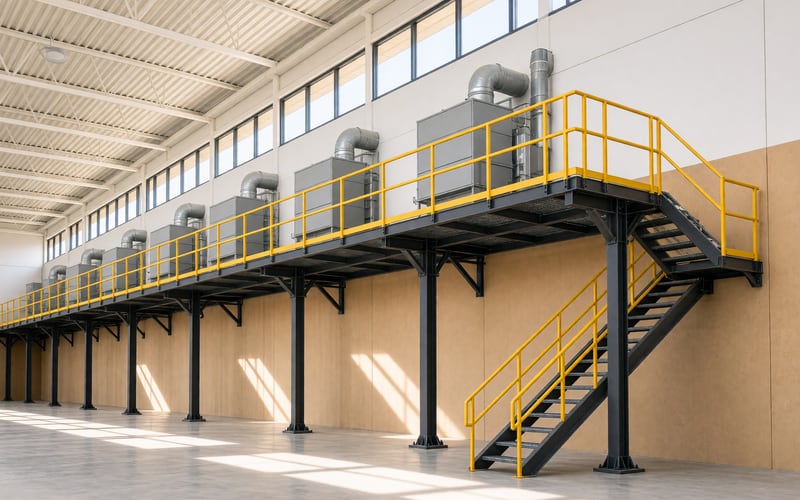
- Equipment access walkways: top rail and midrail, checked against the 21-inch sphere.
- Pallet drop bays: gates in place of a rail section that lifts out, as safe as the guard they replace (1910.29(b)(10)).
Can One Deck Mix Different Opening Rules?
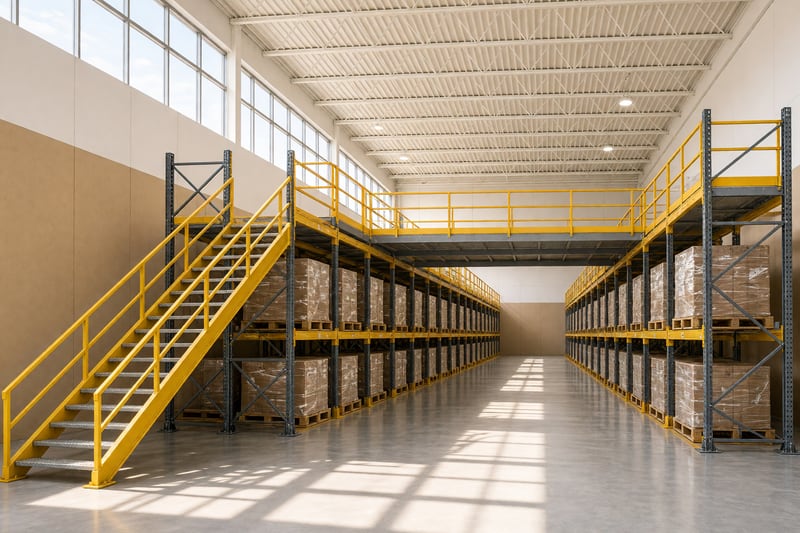
Yes, and many do. The limit follows each edge, not the deck as a whole. A storage deck that only staff use may take the 21-inch sphere along its racks, while the stretch beside an office door, a stair landing the public can reach, or a sales loft takes the 4-inch test. Along every stretch, the federal 19-inch cap still applies to balusters and similar members.
Mixing rules can save material, but it adds joints and changes of infill along the edge. Sometimes one infill type run all the way round is simpler to build and to inspect. We show you both options with their trade-offs before the drawings are sealed.
How Do We Pick the Infill for Your Deck?
We map each edge before choosing. For every open side we note the occupancy, who can reach it, what is stored nearby and what sits below. The drawing then names the sphere or gap limit for that edge and the infill that meets it, so plan review can follow the reasoning.
The whole job comes from one place: we supply the guards, gates and deck, and our own crew puts them up. Start with mezzanine installation in Phoenix to see the full range.
Guard Opening Questions, Answered
Do warehouse mezzanine guards in Phoenix need 4-inch openings?
Not always. The 4-inch sphere is the general rule in IBC 1015.4. Areas not open to the public in Group F, H, S or I-3 may use a 21-inch sphere, and ADOSH still caps baluster gaps at 19 inches. Plan review sets the occupancy.
Source: IBC 1015.4; 29 CFR 1910.29(b)(2)
Is a top rail and one midrail enough on a mezzanine in Phoenix?
Under the federal rule, a midrail set midway up is one accepted option. Under the building code, it works only where the 21-inch sphere exception applies, because its gaps are far wider than 4 inches.
Source: 29 CFR 1910.29(b)(2)(i); IBC 1015.4
Does the 19-inch ADOSH limit apply to mesh and panels in Phoenix?
Yes. Under 29 CFR 1910.29(b)(2), screens, mesh and other members between the top rail and the deck may leave openings no wider than 19 inches. Mesh panels usually have much smaller openings, so the building code sphere test tends to decide.
Source: 29 CFR 1910.29(b)(2)
What opening rule applies on a Phoenix equipment walkway?
IBC 1015.4 lets guards at elevated walking surfaces used to reach electrical, mechanical or plumbing systems or equipment use a 21-inch sphere. The ADOSH rail rules still apply to the workers who use the walkway.
Source: IBC 1015.4
Sources, read November 2026: Phoenix Building Code 2024, Chapter 10 means of egress, via UpCodes · Phoenix Building Code 2024, Section 505, via UpCodes · OSHA 29 CFR 1910.29 · Ariz. Admin. Code R20-5-602, via Cornell LII