Workplace safety guide · ADOSH
ADOSH and Your Mezzanine: How Arizona Applies the Federal Fall Protection Rules
Arizona runs its own workplace safety program, ADOSH, and it brings in the federal general industry rules by reference. Read as written, that puts the 2016 federal walking-working surface rules, the ones covering mezzanine edges, stairs and gates, in force at Arizona workplaces.
Who Enforces Workplace Safety Rules in Arizona?
The Arizona Division of Occupational Safety and Health, known as ADOSH. OSHA's state plan page says ADOSH "is part of the Industrial Commission of Arizona (ICA)" and that its main office is in Phoenix. The Arizona plan covers private-sector workplaces in the state, with listed exceptions, and it reaches state and local government employers too.
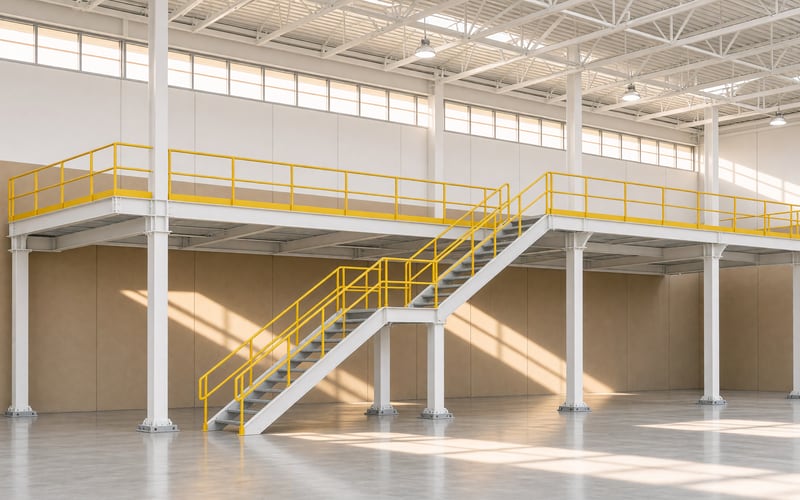
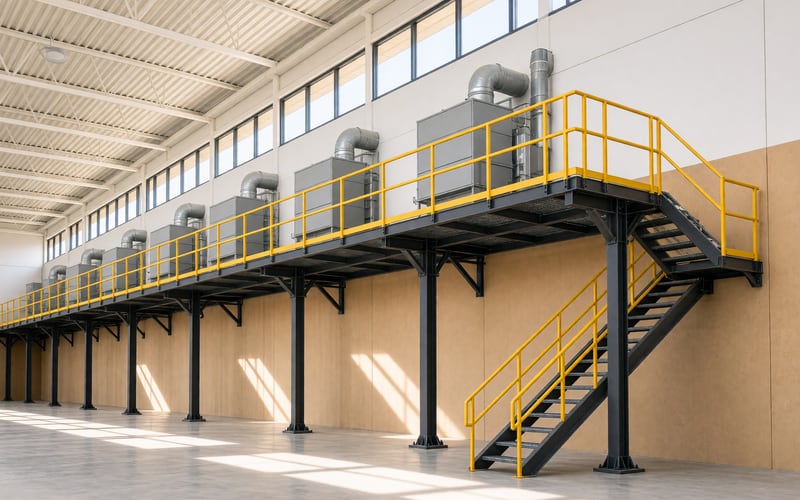
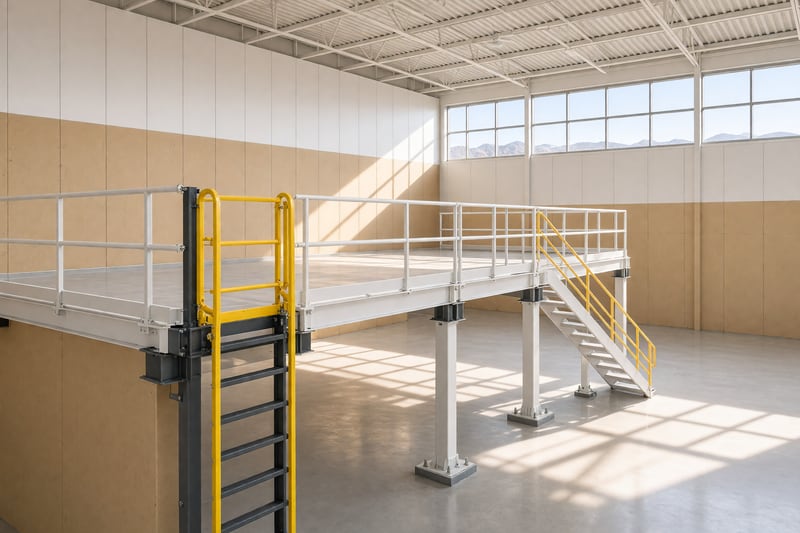
So the rails, stairs and gates on a Valley warehouse mezzanine answer to ADOSH. Our page on mezzanine stairs, railings and gates in Phoenix shows the parts we supply to meet those rules.
How Does Arizona Adopt the Federal OSHA Rules?
By reference, through Arizona Administrative Code R20-5-602. The rule says each employer "shall comply with the standards in Subparts B through Z inclusive" of 29 CFR 1910, "with amendments as of July 14, 2020, incorporated by reference." It reaches public and private employers in general industry. Construction work sits under a separate rule, R20-5-601.
The date matters. The rule states that it "does not include amendments or editions to 29 CFR 1910 published after July 14, 2020." The Arizona rule itself was last amended effective September 4, 2022.
Why Do the 2016 Walking-Working Surface Rules Apply in Arizona?
Because they came before Arizona's cut-off date. The federal rule "Walking-Working Surfaces and Personal Protective Equipment (Fall Protection Systems)" was published on November 18, 2016 and took effect on January 17, 2017. That is well before July 14, 2020. So Subpart D, sections 1910.21 to 1910.30, sits inside the text Arizona adopted.
That is how R20-5-602 reads. Arizona also keeps a short list of standards of its own, one of them titled Fall Protection, and OSHA's page does not say which industry it covers. ADOSH offers on-site consultation services to employers, which is the place to confirm how its rules reach your site.
Where Does a Mezzanine Edge Need Fall Protection?
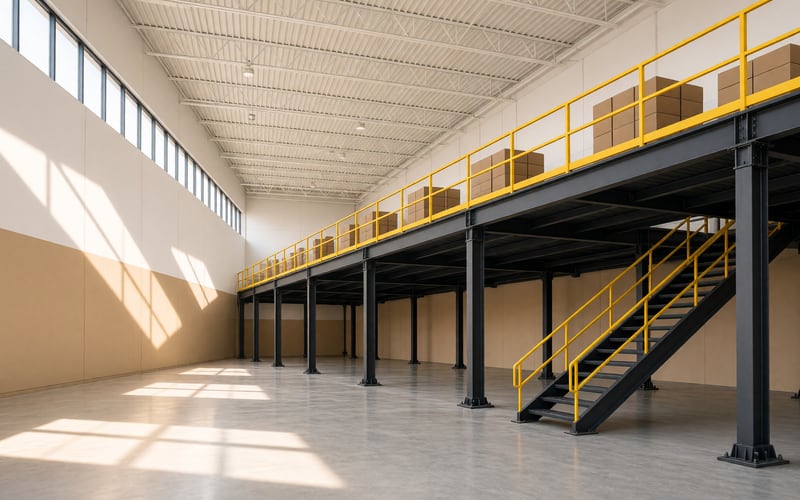
Wherever the drop from an open side reaches 4 feet. Paragraph 1910.28(b)(1)(i) then asks for one of three protections: guardrails, safety nets, or fall protection the worker wears. A mezzanine almost always gets guardrails, since people walk and handle stock beside the edge for whole shifts.
Subpart D defines a guardrail system as "a barrier erected along an unprotected or exposed side, edge, or other area of a walking-working surface." A deck with 7 feet of clear space beneath it is already past the 4-foot line. The building code starts guarding lower, at 30 inches; our guide to guards at 30 inches or 4 feet compares the two.
What Must a Guardrail Meet Under 1910.29?
A set height, set strengths and a cap on gaps. The top rail sits "42 inches (107 cm), plus or minus 3 inches (8 cm), above the walking-working surface." It has to stand up to 200 pounds of force, aimed down or outward near its top edge, without sinking below 39 inches. Midrails, balusters, mesh or panels fill the space underneath.
| Item | Figure | Paragraph |
|---|---|---|
| Top rail height | 42 in, plus or minus 3 in | (b)(1) |
| Midrail | Halfway up between top rail and deck | (b)(2)(i) |
| Gap between balusters | 19 in or less | (b)(2) |
| Top rail force | 200 lb, downward or outward | (b)(3) |
| Top rail under that force | Holds at 39 in or higher | (b)(4) |
| Midrail force | 150 lb, downward or outward | (b)(5) |
| Toeboard | 3.5 in tall or more | (k)(1)(ii) |
Our guide to guard openings sets the 19-inch figure beside the building code's sphere tests.
How Are Pallet Drops and Floor Openings Protected?
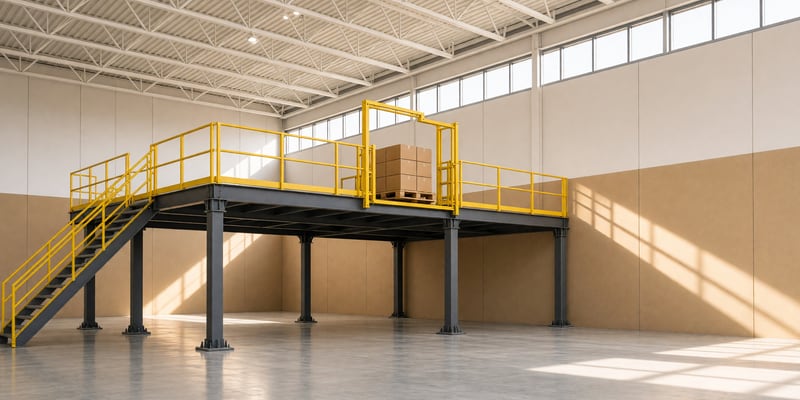
With rails, gates or fall arrest, depending on the opening. Subpart D calls a pallet drop a hoist area: "any elevated access opening to a walking-working surface through which equipment or materials are loaded or received." Once the fall would be 4 feet or more, workers at a hoist area need guardrails, fall arrest gear, or a travel restraint that keeps them back from the drop. If a rail section comes out and someone must lean through, that person wears personal fall arrest.
- Chains or gates: may stand in for a rail section that lifts out, provided the employer shows they are as safe as guardrails (1910.29(b)(10)).
- Ladderways and access holes: "a self-closing gate that slides or swings away from the hole," or a rail layout offset so nobody can step straight in (1910.29(b)(13)).
- Other holes: any hole with a drop of 4 feet or more, skylights included, needs protection too (1910.28(b)(3)(i)).
Do Stairs and Fixed Ladders Fall Under the Same Rules?
Yes, Subpart D covers both. Under 1910.28(b)(11)(ii), stair rails and handrails go on every flight that reaches 3 treads and 4 risers. Fixed ladders over 24 feet that went in on or after November 19, 2018 need "a personal fall arrest system or a ladder safety system." From November 18, 2036, every fixed ladder under that paragraph must have one.
Stairs also face the building code's own riser, tread and width figures, which are tighter. Our guide to building code and ADOSH stairs sets them side by side.
Who Checks the Building Code, and Who Checks ADOSH Rules?
Two different bodies. Phoenix plan review checks the drawings against the building code before a permit is issued. ADOSH enforces the workplace rules where people work, and it uses OSHA's Field Operations Manual to guide that work. Federal OSHA still covers some sites, such as contractors on federal establishments where the federal government alone has jurisdiction, and work on Indian reservations.
The two sets of numbers do not always match. We draw each edge, stair and gate so it satisfies both wherever they part ways. See how that works across a whole job on our mezzanine installation in Phoenix page.
ADOSH Questions, Answered
Is ADOSH the same as federal OSHA in Phoenix?
No. ADOSH is Arizona's own state plan, part of the Industrial Commission of Arizona, with its main office in Phoenix. It adopts the federal general industry standards by reference, so the rule text it enforces is the federal text.
Source: OSHA, Arizona State Plan
Do the federal guardrail rules apply to a Phoenix warehouse mezzanine?
Yes, as Arizona's rule reads. R20-5-602 adopts 29 CFR 1910 Subparts B through Z as of July 14, 2020, and the 2016 walking-working surface rules in Subpart D took effect in 2017, before that date.
Source: Ariz. Admin. Code R20-5-602; Federal Register 2016-24557
Does ADOSH cover a mezzanine on a federal site near Phoenix?
Not always. OSHA's Arizona page lists contractors and subcontractors on federal establishments where the federal government alone has jurisdiction among the exceptions, so federal OSHA covers that work.
Source: OSHA, Arizona State Plan
Can ADOSH help a Phoenix employer check a mezzanine?
ADOSH offers on-site consultation services that help public and private employers comply with ADOSH standards. That is a good place to raise questions about rails, gates or ladders at your site.
Source: OSHA, Arizona State Plan
Sources, read November 2026: OSHA, Arizona State Plan · Ariz. Admin. Code R20-5-602, via Cornell LII · Federal Register 2016-24557, Walking-Working Surfaces · OSHA 29 CFR 1910.21 · OSHA 29 CFR 1910.28 · OSHA 29 CFR 1910.29